Tourette Syndrome and the Nword

Up until a few days ago, most people gave little to no thought to Tourette Syndrome. If pressed, they would probably say something like “That’s the disease that makes people swear, right?” Now, suddenly everyone seems to have an opinion about it – what it is, how it works, whether it’s even “real…” Sadly, a large number of these opinions are woefully uninformed, with a distressingly high percentage of them being rooted in toxic, willfully ignorant, ableist bigotry; demonizing a man with a condition they don’t understand without bothering to inform themselves about his condition. The generous opinion I have about his is that it is an unfortunate by-product of a culture dumbed down by social media, resulting in a short attention span society too lazy to inform themselves, and able to share their uninformed opinions without consequence, thanks to the anonymity afforded by said social media. The more cynical opinion I have is that people refuse to inform themselves because they are afraid that actually learning about it will poke holes in their victimhood narrative. The truth, most likely, lies somewhere in between.

I have lived with Tourette Syndrome for 50 years. My first symptoms began to present as mild motor and vocal tics – shaking my head, blinking my eyes, and throat clearing/ grunting) when I was five. My parents took me to a child psychologist, neurologists, and other “experts” to find out what was wrong. My tics became more severe as I got older, and as I progressed through elementary school, they became a source of nearly constant stress and anxiety. One of the cruel ironies of TS is that the tics that are its hallmark are exacerbated by stress – leading to a vicious circle of more intense tics, which lead to more anxiety, which leads to more intense tics, lather, rinse, repeat. TS tics have a nasty habit of flaring up at the worst possible time – giving an oral report in class, talking to person you’re attracted to, a job interview, etc. My childhood tics tended to get particular bad when I was trying to concentrate in class – particularly the vocal, grunting ones. Being elementary school, of course the other kids in class would giggle and whisper. This led, on more than a few occasions, to me being sent out to sit in the hall for “being disruptive.”

When I was thirteen, my mom read an article about a doctor at the City of Hope hospital in Los Angeles named David Comings, who was doing pioneering research into a little-known behavioral disorder called Tourette Syndrome. We lived in Southern California at the time, so she called his office and made an appointment. I went along, sure that this was going to be just one more windmill-chasing expedition to see some quack who would tell us “You need to reduce his stress level.” I couldn’t have been more wrong. That one doctor visit was a life changing experience. For the first time, a doctor listened to me about my tics and explained what they were, rather than dismissing them as “the product of stress.” This guy understood that my tics were the source of my anxiety, not a product of it. . in some ways, my life is divided into “before diagnosis” and “after diagnosis.”

I had no idea just how much stress and anxiety I had been carrying, or just how much of it was from not knowing what my condition was. Finally having a name for it, and an idea of how it worked was indescribably liberating. My parents still sometimes mention the transformation that occurred in me after that diagnosis and how, while my tics didn’t come close to going away, they almost instantly dropped about 50% in intensity and became much less frequent. I year later, I was starting High School, and was able to be much more comfortable in my own skin than I had ever been in an academic setting. I was fortunate enough to have relatively mild tics that, while not invisible, were not anti-social. I still got questions, and the occasional teasing, but nothing like the bullying and judgement like I had in elementary and middle school.

All this to say that, even though I had about as easy a time with Tourette Syndrome as anyone possibly could, it was still incredibly difficult. While most days were fine, I would occasionally have rough days – an outburst in class, accidentally winking at a girl who thought I was being inappropriately flirty, classmates laughing when I had a  particularly intense tic flurry as I approached the lectern to read an essay, etc. These incidents were sometimes so mortifying that they would send me into a shame spiral that made it impossible to engage or concentrate in class. I was one of the smartest kids in school, but got poor grades because I was checked out much of the time.

So I can only imagine what life is like for someone Like John Davidson, the man who shouted the N-word at the BAFTAs. The component of TS that causes those verbal outbursts, known as Coprolalia, is one that I have the good fortune to not count among my symptoms. But even with my relatively mild experience with TS, I can understand an empathize with Mr. Davidson’s situation. I can guarantee that his first reaction, upon realizing what tic he had just had, was to hope against hope that no one had heard it, that it wasn’t to loud, maybe hoped that he had just muttered it under his breath; that’s not an illusion one can maintain in that situation for more than a few seconds. Then comes the panic-induced trauma response. I’m sure all Mr. Davidson could think of at the moment was how to shrink down to an invisible size, or find a hole to fall into and disappear.

Mr. Davidson has been criticized for not immediately apologizing to Michael B Jordan and Delroy Lindo. And now that it has come to light that he is working to apologize to them in person, the criticism is that he waited too long to do so. That’s horseshit. Someone feeling that sort of trauma is going to take a bit of time to get back to a place where they can even begin to express an apology. And it took almost no time for a ridiculous media outrage circus to grow up around the situation, with clueless celebrities like Jamie Foxx insisting that the word was not the result of TS, but what Davidson felt in his heart. While I can totally understand that the people involved would be horrified, shocked, and offended in the moment by the use of that word; after the moment was over, and the shock of it had worn off, there is no excuse for demonizing a disabled person and claiming to know what was in his heart instead of trying to understand why it happened. Grown-ass adults, with no idea what they’re talking about have made a toxic soup of this situation that could have been a teachable moment about both Tourette Syndrome and racism; how can someone be expected to make a real, meaningful apology in that environment? It totally makes sense that he would want to reach out to the actual affected people and make his apology personally to them, rather than make a performative one in the press for ignorant, ableist bigots to rip apart.

If you need a villain for this story, let’s talk about the BBC production. Davidson was seated in the 40th row, where he placed himself to be far from the stage and avoid disrupting the show; for some reason, the BBC production staff placed a microphone near him. The show was broadcast on a delay, and many other offensive words, including “free Palestine” were bleeped out, but not this one. How many people, who just last week didn’t even know the BAFTAs existed, now have it as their primary topic of conversation? What makes this so infuriating for me is that there is, unfortunately, so much actual racism in the world that needs to be addressed, but people are opting instead for performative outrage; punching down at another marginalized person to create the illusion of real activism. The response to requests for people to educate themselves about Tourette Syndrome and better understand the situation has been a resounding “Nah…” I can only assume that the reason for people’s refusal to learn is that they are worried doing so will spoil the narrative they’ve built for themselves; it’s much easier, and gets more clicks, to just stay ignorant and keep hating…
Thoughts on CRT and White Privilege…

If you look at me on paper, it would be easy to assume that I’m some sort of villain. I’m a middle class, middle aged, white, cis gender, heterosexual male. From the time I was eleven years old, I was raised in an affluent, master planned neighborhood in South Orange County, California that was filled with houses and perfectly manicured lawns that all looked the same. One of my high school teachers casually referred to it as a “golden ghetto” because it was so self-contained and sheltered. This was not an environment that enabled young men like me to acknowledge, or even realize, the privilege we really had. In fact, that sort of thinking was actively discouraged. At the time, with no other frame of reference, it was easy to think of myself and my peers as basically good people without ill will toward anyone. In hindsight, there was an air of “soft” white supremacy that permeated every moment and situation in the community. But I wasn’t able to see it until I left for Texas and had my world rocked.

            This ignorance of our own advantages was no accident. One of the core concepts of Critical Race Theory is that in order for the machinery of white privilege to be effective, it must remain at least hidden enough for the privileged class to maintain plausible deniability of their advantages.  “Thus, the dominant position of whites in the socioeconomic hierarchy and the advantages that are implicit in this dominant position are taken for granted and hidden from most whites.”(Tranby) While it may seem obvious to those observing from outside the enclave of privilege, white privilege stays actively hidden from the privileged, although they are usually willing participants in their own hoodwinking. “The status of whiteness is maintained by never acknowledging its privileges but rather by assuming white privilege is the norm, or the ‘way things are.’” ( Hurtado) The illusion is much easier to maintain than one might think, given that those enjoying the advantages of privilege are not terribly motivated to reflect on or discover how they are being fooled.

            “An additional complexity to mention about the issue of privilege is the tendency for White people to deny their White privilege based on marginalized status they hold in other dimensions of their identities”(Forrest-Bank). While my family may have been considered well off compared to society at large, we were near the bottom of the socioeconomic ladder in our own community. We lived in one of the few single story homes in our housing tract, and while our friends left for ski vacations during winter break, my brother and I helped out with our parents’ “side hustle” of labeling and boxing VHS Christmas Cards that they shot and duplicated for our neighbors. These were not terrible hardships by any stretch, but when everyone else in the neighborhood seems to be doing so much better, it’s not hard to convince yourself that you’re not so well off.

            Also, my parents were divorced a couple of months before I turned three. Before my mother remarried and we moved to the nice neighborhood, my brother and I were “latchkey kids” who let ourselves into our little apartment after school and spent the afternoons unsupervised while we waited for our working single mother to get home from work. It was the 1970s, and daycare wasn’t nearly as available or affordable as it is now; it certainly wasn’t provided by employers. During this time, we also moved around a lot. From Kindergarten to sixth grade, I attended six different elementary schools. Even after we settled into the home we would stay in through high school, I struggled to form long term friendships. I was good at making friends but hadn’t developed the skills required for maintaining relationships, and instead I spent my teenage years shifting from one social group to another. This economic and social instability provided a ready back story for me to point to in support of my denial of being part of a privileged class.

            These illusions I’d built up started to crumble shortly after I turned twenty, when I moved to Texas to live with my biological father. He lived, with my step mother and half sister, in a double wide mobile home on his in-laws’ ranch. Here, my role was flipped; whereas before I had been the poorest among the “rich kids,” now I lived in far lower socioeconomic conditions but was a member of one of the most affluent families in a poverty-stricken rural town. And here, no one tried to hide their racial bias and prejudice. I was shocked at the way the n-word rolled as easily off our neighbors’ tongues as “hello” did off mine. There was no question who were the privileged class and who were the second class citizens, and yet these obviously privileged white people would still bristle at the suggestion that their race had given them any sort of a leg up on their brown skinned neighbors. “Another way to naturalize white privilege is to claim that the special treatment is unrelated to whiteness; rather, it is claimed, the treatment meets a special need that would be accorded to anyone, regardless of race.”(Hurtado) Despite all evidence to the contrary, the white people of Palmer, TX had themselves convinced that their privileged status resulted not from accident of birth, but from differences in values and work ethic.

            At first, I looked down my nose at these small town folks; judging them harshly as a bunch of hicks for their overt racism. But after a year of living among them, I noticed that their actual treatment of their minority neighbors, in spite of their overtly racist language, was not very different from how we did things back home. “Perhaps the central overarching theme in scholarship on whiteness is the argument that white identity is decisively shaped by the exercise of power and the expectation of advantages in acquiring property”(Roediger, David R. “Critical Studies of Whiteness, USA: Origins and Arguments.” (Roediger). These were not people who put on white robes and hoods and rode around burning crosses on black families’ lawns. They were just a bunch of regular people who found themselves in a position of privilege and convinced themselves that they had earned that spot through their own ingenuity and industry, rather than by being given a head start by systemic racial privilege. Seeing these similarities made it much more difficult for me to cling to my own illusions about my privilege and racial bias. As this made me very uncomfortable, I decided I needed to move to the city and get away from it.

            But Dallas was no more forgiving; the genie was out of the bottle. But it was a metropolitan city, with all the racial and cultural diversity that provides. For the first time in my life, most of the people with whom I came in contact were nothing like me, but stood on equal footing as my peers. Black, Latino, Asian, Queer, etc. were no longer just abstract stereotypes, but real people who shared the world with me. While it’s a bit embarrassing to look back on it know and remember what a shock that was at the time, this was really a life changing time for me. While this realization was sort of the last nail in the coffin of my illusions about white privilege, it also showed me that the class structure I had known up until then was not the only one possible. One of the most devastating realizations I had living in my father’s small town was that I was just as much trapped by this system as anyone else, even though it seemed to work to my benefit. Seeing the possibility of breaking out of that system was both liberating and terrifying; I didn’t handle it well early on.

            Being shown the possibility of a different system energized me to try to help build it. I began to see myself as coming to the rescue to make the world a better place. Now that I could see it, I was going to fix racism. Unfortunately, my idea of how to do that at the time mostly consisted of t-shirts, music and food choices, arguing with my parents, and bumper stickers. While my intentions may have been good, I was still buying into the idea that I was somehow more capable and able to affect change by virtue of my skin color. But over time, as I was given the opportunity to work with and befriend members of these traditionally disadvantaged classes, they were kind and patient enough to gently educate me in how to shut up and listen in order to take my ego out of the mix while I fought the good fight. With their guidance, I eventually figured out that I could be most helpful to them, not by riding in to the rescue on a white steed, but by just not being a jerk and encouraging my fellow white men not to be either. This isn’t always easy.

            Most white men are still very much unaware of their privilege; pointing it out to them will usually make them defensive and hostile. But while we did not ask for this privilege, and can be excused for not working against it while we are still ignorant of it, we have an obligation to acknowledge and challenge this disparity once we are made aware of it. That doesn’t mean we should all go to BLM rallies or dance on floats in gay pride parades; in fact that would be counter productive in most cases. But we do need to recognize that we have been granted some advantages in life and listen to those who have been abused by the system that granted us that privilege. This can be difficult. Being confronted by the pain and abuse heaped on those who are marginalized for the purpose of maintaining a system that privileges us can be devastating. But in the long run, it can help us to be better people. Not heroes or saviors, just better people. As Maya Angelou said, “When we know better, we do better.” And if we just try every day to be that better person, we really can help to change the system into one that is more equitable. Even though on many days we’ll get it all wrong, if enough of us are trying to be better, we will be better.

Works Cited

Tranby, Eric  and Hartmann, Douglas. “Critical Whiteness Theories and the Evangelical ‘Race Problem’: Extending Emerson and Smith’s ‘Divided by Faith.’” Journal for the Scientific Study of Religion, vol. 47, no. 3, Blackwell Publishing, 2008, pp. 341–59

Hurtado, Aída. “Critical Race Theory and Questioning Whiteness: Young Feminists Speak Out   Against Race and Class Privilege.” Frontiers (Boulder), vol. 40, no. 3, University of           Nebraska Press, 2019, pp. 90–116

Roediger, David R. “Critical Studies of Whiteness, USA: Origins and Arguments.” Theoria             (Pietermaritzburg), vol. 48, no. 98, Berghahn Journals, 2001, pp. 72–98

Forrest-Bank, Shandra. “Understanding and Confronting Racial Microaggression.” Critical Social Work, vol. 17, no. 1, University of Windsor, 2019

Police Brutality, now what?

So, lately it seems we’ve all had reason and opportunity to contemplate the police. Who do they really work for? What is their real mission? How do they actually affect the day to day lives of the average citizen. One of the things I’ve come to realize is that the real function of the police is to keep the population in line. “To Protect and to Serve” is a marketing slogan that doesn’t really align well with their actual mission.

What has really come to the forefront of my awareness is that there are two possible routes to achieving this goal of keeping the population sedate and compliant; respect-based and fear-based. The respect-based approach involves being of service, demonstrating integrity and professionalism, cooperation, and collaboration. The fear-based approach relies on intimidation, harassment, and brutality.

The respect-based approach is more difficult; it requires a great deal of impulse control and patience to build trust and partnerships with the citizenry. The upside is that, once established, this relationship is very strong and stable; it is much easier to repair when it “breaks”. If the police begin to fall off on their end of the partnership and they begin to lose the “buy in” from the citizens, the track record of having been helpful and respectful will make it possible to rebuild and renew the partnership with a renewed dedication to that service and respect.

The fear-based approach is easier in the short term; when you have the guns, the hand cuffs, the prisons, etc. it’s a simple matter of keeping people under your thumb with brute force. It works great for awhile, but over time the brutality required to maintain it creates resentment that grows into anger. When that anger grows into rage the fear-based compliance begins to erode. The fear-based approach doesn’t include a component of trust or “buy in” from the citizens, so the option of stepping up service and respect simply won’t work in this situation; the foundation for it just isn’t there. So the only option is to crank up the brutality and hope to cow the population back into submission. This works… until it doesn’t. Eventually, the population’s rage and resentment will grow to the point that they over-ride their fear.

We’re starting to see that now. Police “riot control” tactics are designed to work as a sort of “shock and awe” campaign. The idea is to confront the population with an overwhelming show of force and brutality, inflicting as much pain and damage as possible to intimidate them back into submission and compliance. It’s quite effective when it works right away, but it is not sustainable. There are a finite number of police officers in any department, and this level of force requires all of them to work long, stressful shifts; after just a few days, they start to get fatigued and their resources get scarce. When the population’s outrage reaches the point where this intimidation no longer works, and they keep coming back, the police then have nowhere to go. They’ve already turned their brutality “up to 11;” there is no more to bring, and they have no other options.

That is where we find ourselves now. It is starting to sink in to the leadership of both municipalities and their police leadership that they are up against it. We are starting to see concessions being offered; Minneapolis has floated the idea of disbanding their police department and rebuilding it from scratch. Seattle declared a 30 day ban on tear gas (a promise that has proved hollow, but that’s another essay…).

So, now that these police departments are seeing the effectiveness of their fear-based approach slip away, they are attempting to move to the respect-based approach. They need to be aware that simply paying lip service to these ideals and not following through with real, good faith action will only make the problem worse. Seattle PD promising to stop using tear gas, and then just lobbing some new type of pepper spray grenades instead, is not going to cut it; they are going to need to stop dressing for a riot and then wondering why a riot broke out.

It is on the police to earn back the trust they have violated from the population they have brutalized. They can do it, but it will take a lot of work and sincere humility and contrition. They’ve got a LONG way to go to make it happen. But, if they can set aside their egos and really do the work, the population they have so abused will eventually come around and work with them because, in the end, we really all do just want to get along…

Seriously?

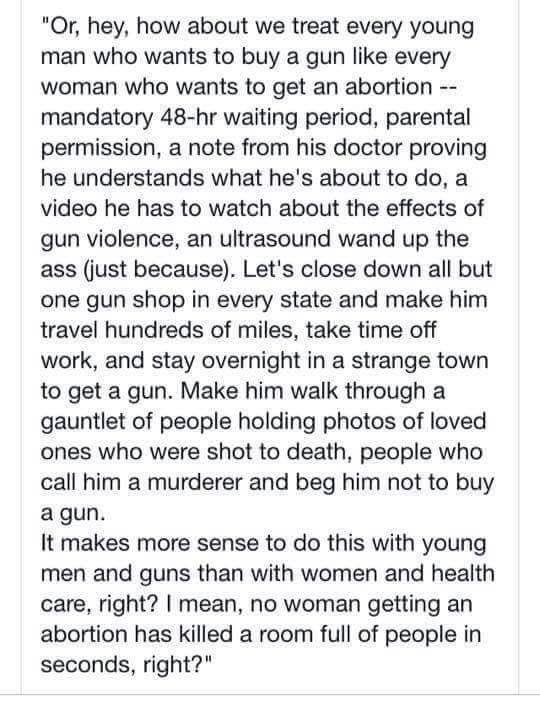
Here we are, talking about yet another school shooting, and the conversation hasn’t changed. This is embarrassing! We, as adults, should be capable of rationally discussing a solution to a very real problem; instead, we’re shouting at each other about the second amendment while children continue to be senselessly slaughtered.

SHAME ON US!!

And I’m done with the false equivalency. There is a right side and a wrong side in this debate. The pro-gun community has repeatedly dropped the ball on adulting about this issue over the last decade or so. When presented with the opportunity to behave like rational adults, you’ve passed on it in favor of temper tantrums, memes, and bumper sticker slogans; I’m unimpressed. You’ve repeatedly failed to behave like adults, so I’m done talking to you like you’re adults.

After Columbine, it was understandable that y’all had a bit of a chip on your shoulder; this sort of thing had never happened before, and I can see why you wanted to keep heads cool in the conversation and not let hysteria lead to unnecessary and ineffective new gun restrictions.

But then there was Sandy Hook; that’s where you guys really jumped the shark. If you were really the “responsible gun owners” you kept trying to present yourselves to be, you would have been willing to enter into dialogue about how to prevent that sort of horror in the future. Instead you chose to indulge yourselves in ridiculous conspiracy theories about the grieving parents of pre-teen children slaughtered at school being actors paid by George Soros; go fuck yourselves!

You no longer have any credibility, and your input is no longer welcome. You had a chance to be at the table, and you turned it down. Gun regulation will happen, whether you like it or not, and now you’re really going to hate how it goes. Go back to gazing at your navels and let the adults (many of whom, it turns out, are still in High School) handle it. Your childish behavior has turned a generation starting to reach voting age into a solid anti-gun voting bloc; way to go!